Jeremy Vachier
Theoretical Physicist | Associate Director Data Science
Projects
Featured Projects
Scientific Literature RAG System
AI-powered introduction generator for scientific papers
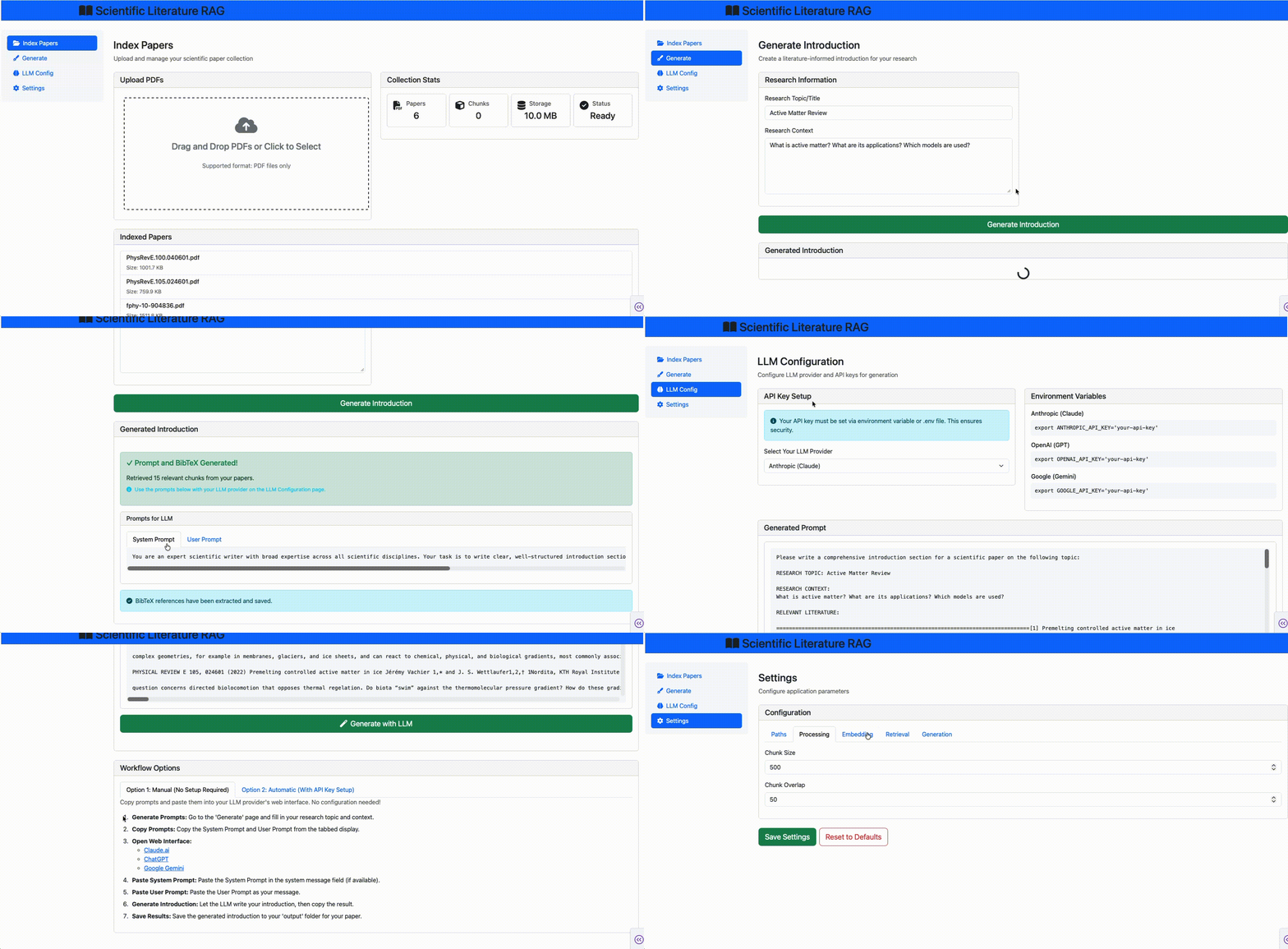
Live demonstration of the Scientific Literature RAG system generating introductions with semantic search and citation extraction.
A production-ready RAG system that automatically generates well-structured, literature-informed introductions for scientific papers. The system indexes research papers and leverages LLMs to synthesize relevant literature into comprehensive introductions with properly formatted citations.
Key Features:
- Multi-Provider LLM Support: Claude (Anthropic), OpenAI GPT-4/GPT-4o, Google Gemini
- SPECTER2 Embeddings: Domain-optimized scientific embeddings for superior semantic understanding
- GPU Acceleration: Metal GPU support for Apple Silicon, CUDA for NVIDIA, automatic CPU fallback
- Smart PDF Processing: Semantic chunking (500-word chunks with 50-word overlap)
- ChromaDB Vector Search: Persistent local storage with cosine similarity search
- Automatic BibTeX Citations: Extracts and formats references with sophisticated metadata extraction
- Interactive Dash UI: User-friendly web interface for literature exploration
- ROUGE Evaluation: Built-in evaluation metrics for assessing generation quality (F1 scores >0.5)
Performance:
- Embedding: 50-100 chunks/second on Apple Silicon
- Generation: 10-30 seconds per introduction
- Indexing: ~1 minute per 100 PDFs
Technologies: Python 3.11+, GPU, LLM, ChromaDB, SPECTER2, RAG, Dash
Status: Production Ready | Apache 2.0 License
→ View on GitHub
Speech-to-Text with Sentiment Analysis and Translation
Real-time multilingual processing pipeline
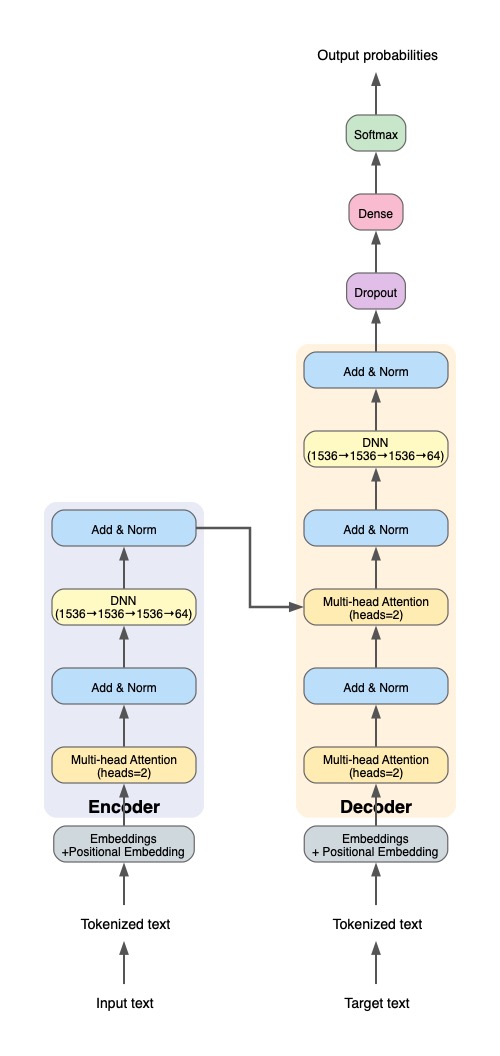
Detailed architecture of the Transformer model showing encoder-decoder structure with multi-head attention mechanisms.
A comprehensive end-to-end system integrating speech recognition, sentiment analysis, and neural machine translation. Built with from-scratch Transformer implementation demonstrating deep understanding of attention mechanisms and encoder-decoder architectures.
Key Features:
- Real-time Speech-to-Text: Audio capture and transcription using Vosk library (English)
- From-Scratch Transformer: Complete encoder-decoder architecture without pre-trained models
- Custom Multi-Head Attention: Manually implemented attention mechanisms with configurable heads
- Positional Encoding: Hand-crafted sinusoidal position embeddings
- Sentiment Classification: Bidirectional LSTM with 95% test accuracy
- Interactive Dash Web App: Real-time processing with visual feedback and export functionality
- Hyperparameter Optimization: Automated tuning with Optuna for both models
- BLEU Score Evaluation: Translation quality metrics and model assessment
Performance Metrics:
- Sentiment Analysis (BiLSTM): 95.00% test accuracy
- Translation (Transformer): 67.26% test accuracy, 0.52 BLEU score
- Real-time processing with instant speech recognition and translation
Architecture Highlights:
- Educational implementation demonstrating core concepts
- Full control over attention mechanisms and positional encodings
- Research-grade code suitable for experimentation
- Clean, well-documented implementation
Technologies: Python 3.11+, Transformer, Bidirection LSTM, TensorFlow, Keras, Vosk, Dash, Optuna
Status: Research/Educational | Apache 2.0 License
→ View on GitHub
→ View Transformer Model on HuggingFace
→ Try Interactive Demo on HuggingFace Spaces
→ View on Kaggle
Active Particles in 3D Confinement
GPU-accelerated molecular dynamics simulation
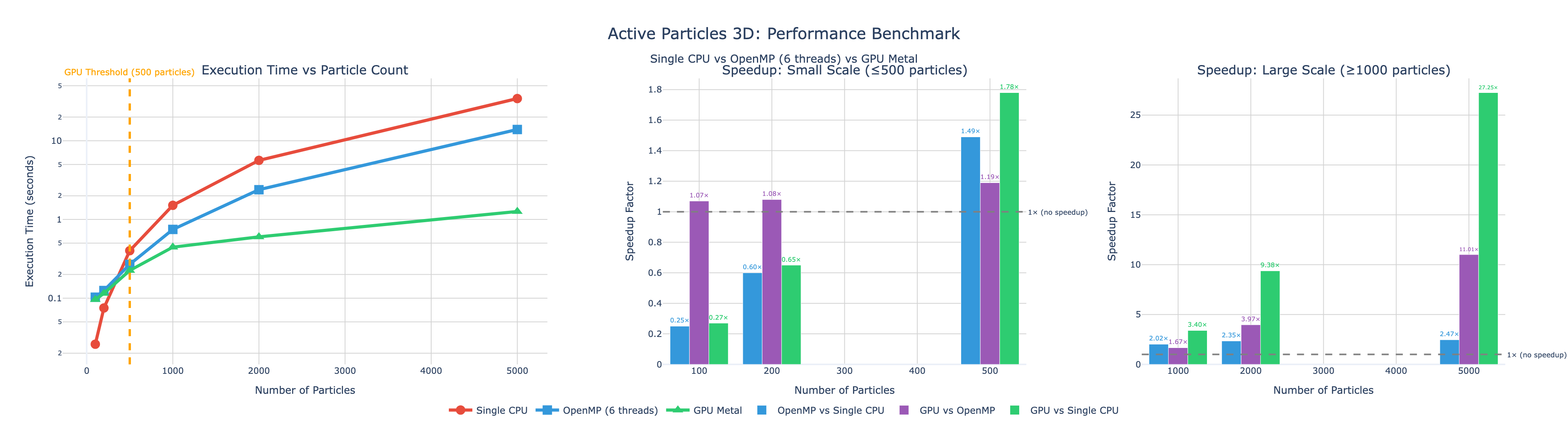
Performance comparison across CPU and GPU implementations showing up to 27× speedup on Apple Silicon.
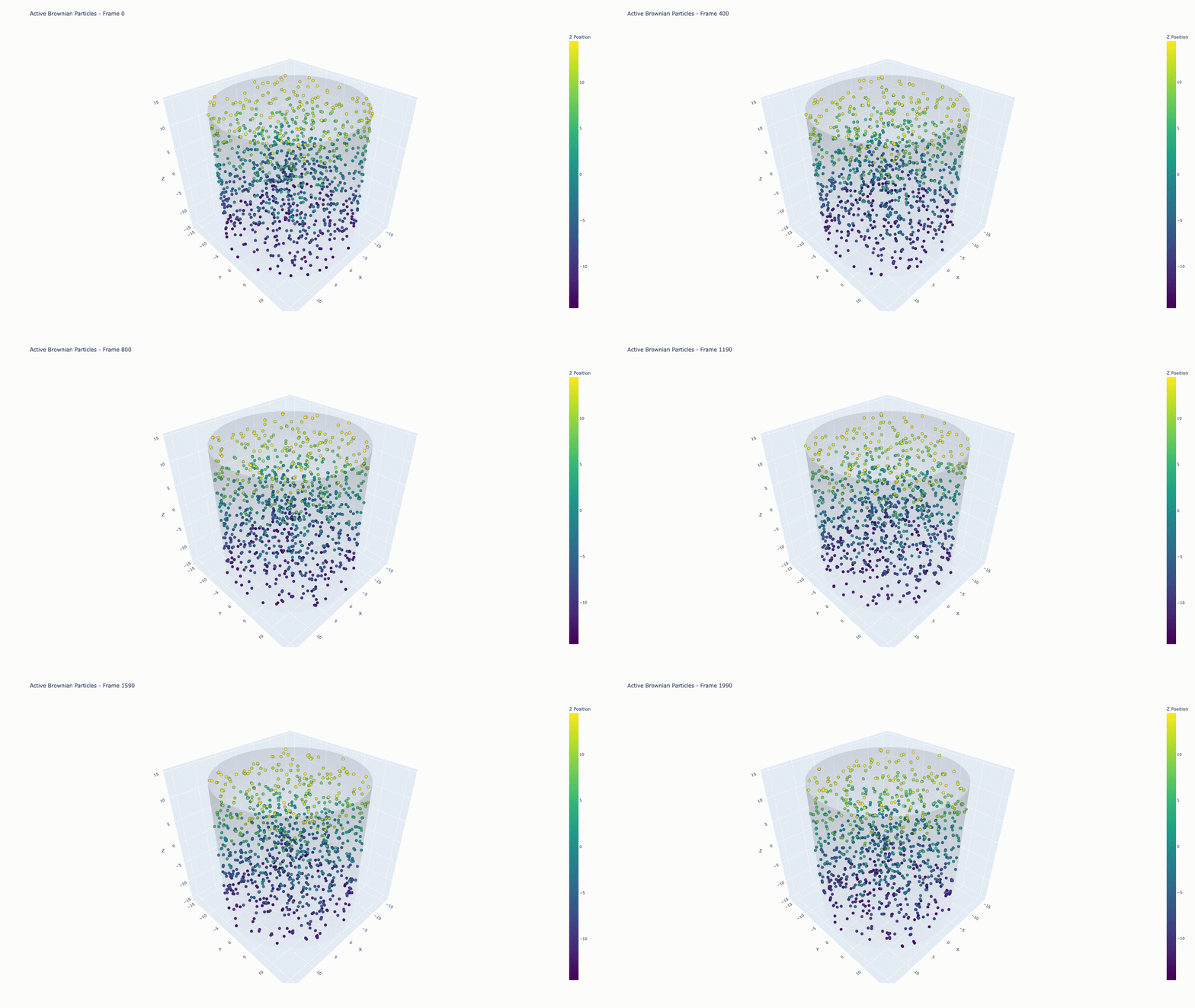
Simulation of 1000 active Brownian particles under 3D cylindrical confinement, demonstrating collective motion and particle-particle interactions with Lennard-Jones repulsion.
A high-performance C++ simulation framework for modeling active Brownian particles (ABPs) under cylindrical confinement in 3D space. Implements Euler-Maruyama algorithm for Langevin dynamics with dual CPU/GPU implementations.
Key Features:
- Dual Implementations: CPU-only (OpenMP) and GPU hybrid (Metal) versions
- GPU Acceleration: Up to 27× speedup on Apple Silicon for large systems (N ≥ 1000)
- Langevin Dynamics: Proper stochastic noise generation with Euler-Maruyama integration
- 3D Cylindrical Confinement: Reflective boundary conditions for realistic physical constraints
- Lennard-Jones Interactions: Repulsive particle-particle forces with configurable strength
- OpenMP Parallelization: Multi-threaded CPU optimization for all particle counts
- Automatic CPU/GPU Selection: Smart threshold-based switching for optimal performance
- Numerical Stability: Robust safeguards prevent NaN overflow at high particle densities
Performance Benchmarks (Apple M2, 1000 timesteps):
| Particles | CPU (1 thread) | CPU (OpenMP 6) | GPU (Metal) | GPU vs 1 CPU | GPU vs OpenMP |
|---|---|---|---|---|---|
| 100 | 0.026s | 0.103s | 0.096s | 0.3× | 0.9× |
| 200 | 0.075s | 0.125s | 0.115s | 0.7× | 1.1× |
| 500 | 0.401s | 0.269s | 0.225s | 1.8× | 1.2× |
| 1,000 | 1.514s | 0.747s | 0.445s | 3.4× | 1.7× |
| 2,000 | 5.638s | 2.389s | 0.601s | 9.4× | 4.0× |
| 5,000 | 34.393s | 13.903s | 1.262s | 27.3× | 11.0× |
Physical Model:
- Active Brownian particles with self-propulsion
- Translational and rotational diffusion
- Repulsive Lennard-Jones potential
- Applications: bacterial suspensions, cell motility, colloidal systems
Technologies: C++17, OpenMP, Metal GPU
Status: Research-Grade | Apache 2.0 License
→ View on GitHub
Personality Classification with Ensemble Learning
Production ML pipeline achieving Kaggle top 5%
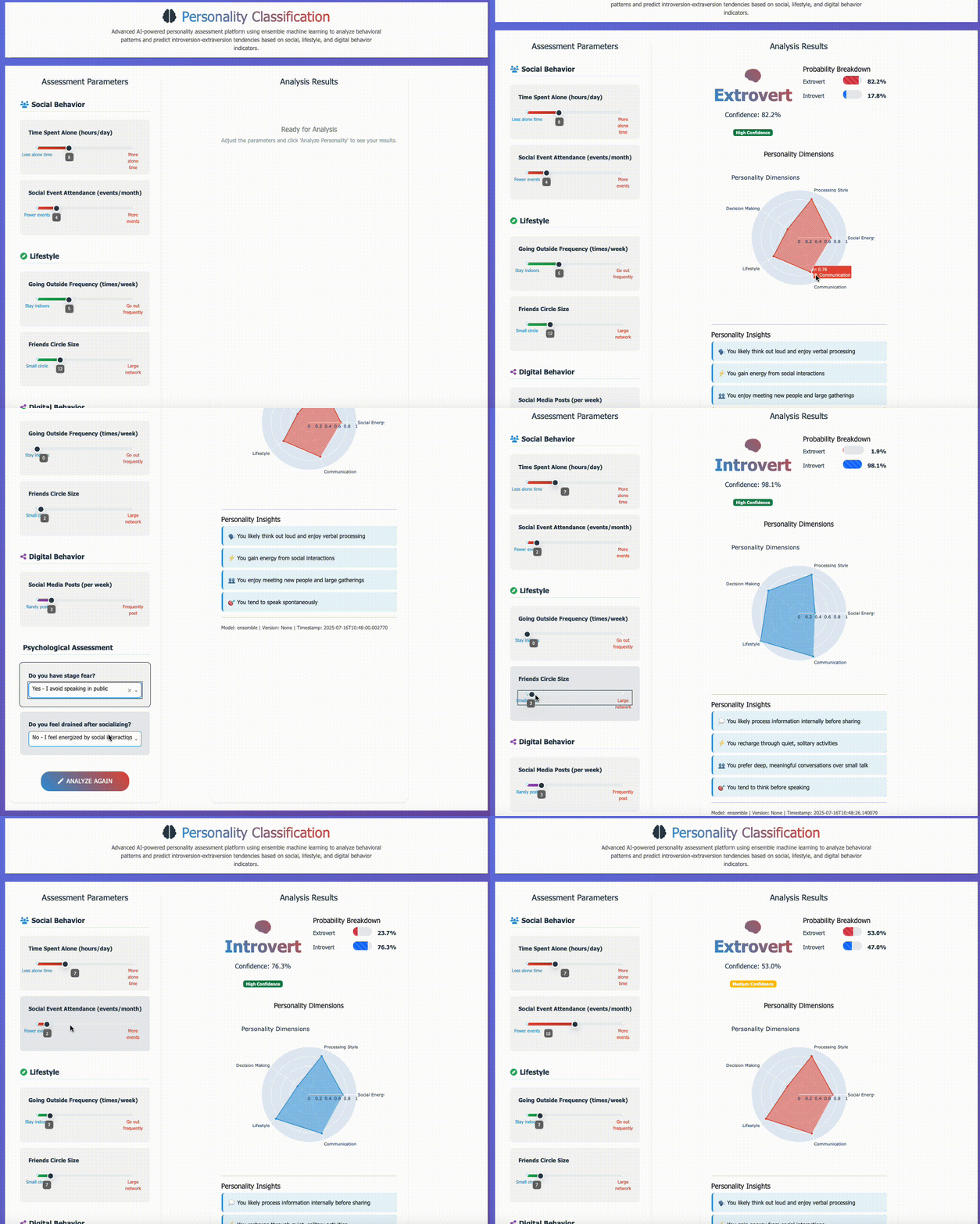
Interactive dashboard for real-time personality classification with model explainability and performance metrics.
A production-ready machine learning pipeline for personality classification using ensemble learning, achieving top 5% (200/4,329) in the Kaggle Personality Classification Competition. Features modular architecture, automated hyperparameter optimization, and interactive visualization.
Key Features:
- Six Ensemble Stacks: Complementary ML algorithms (Random Forest, XGBoost, LightGBM, CatBoost, Neural Networks)
- Advanced Data Augmentation: SDV Copula-based synthetic data generation with quality control
- Automated Hyperparameter Optimization: Optuna-powered tuning for each stack (200+ trials for blending)
- Interactive Dash Dashboard: Real-time predictions, model explainability, and performance visualization
- Meta-Learning Approach: Logistic Regression ensemble combiner with optimized blending weights
- Out-of-Fold Predictions: Unbiased ensemble training with stratified cross-validation
- Production-Ready: Full test coverage, CI/CD pipeline, comprehensive logging
Ensemble Architecture:
| Stack | Focus | Algorithms | Special Features |
|---|---|---|---|
| A | Traditional ML (Narrow) | RF, LR, XGBoost, LightGBM, CatBoost | Stable baseline |
| B | Traditional ML (Wide) | Same as A | Extended search space |
| C | Gradient Boosting | XGBoost, CatBoost | Tree specialists |
| D | Sklearn Ensemble | Extra Trees, Hist GB, SVM, Gaussian NB | Diverse mix |
| E | Neural Networks | MLPClassifier, Deep architectures | Non-linear patterns |
| F | Noise-Robust | Same as A + label noise | Improved generalization |
Competition Results:
- Rank: 200/4,329 (Top 5%)
- Dataset: ~18,000+ training samples (with augmentation), 8 personality dimensions
- Cross-Validation: Stratified 5-fold CV for robust evaluation
Technologies: Python 3.11+, scikit-learn, XGBoost, LightGBM, CatBoost, Optuna, Dash, Plotly
Status: Production Ready | Apache 2.0 License
→ View on GitHub
Industrial Audio Anomaly Detection
Unsupervised anomaly detection for industrial machine audio
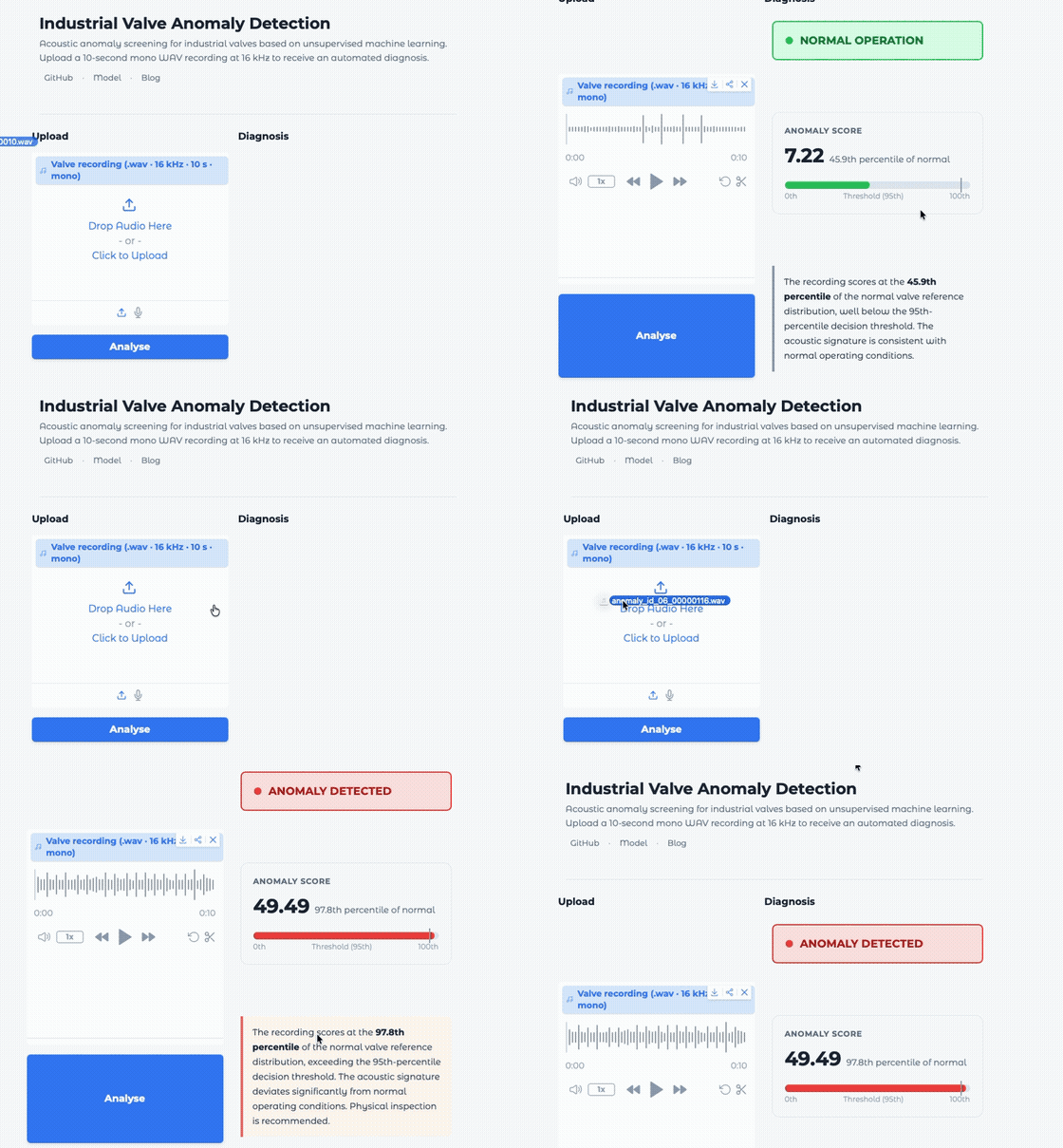
Upload a .wav recording to the Gradio app and get a verdict (normal/anomalous), the pooled Mahalanobis anomaly score, and its percentile against the calibration distribution of normal clips.
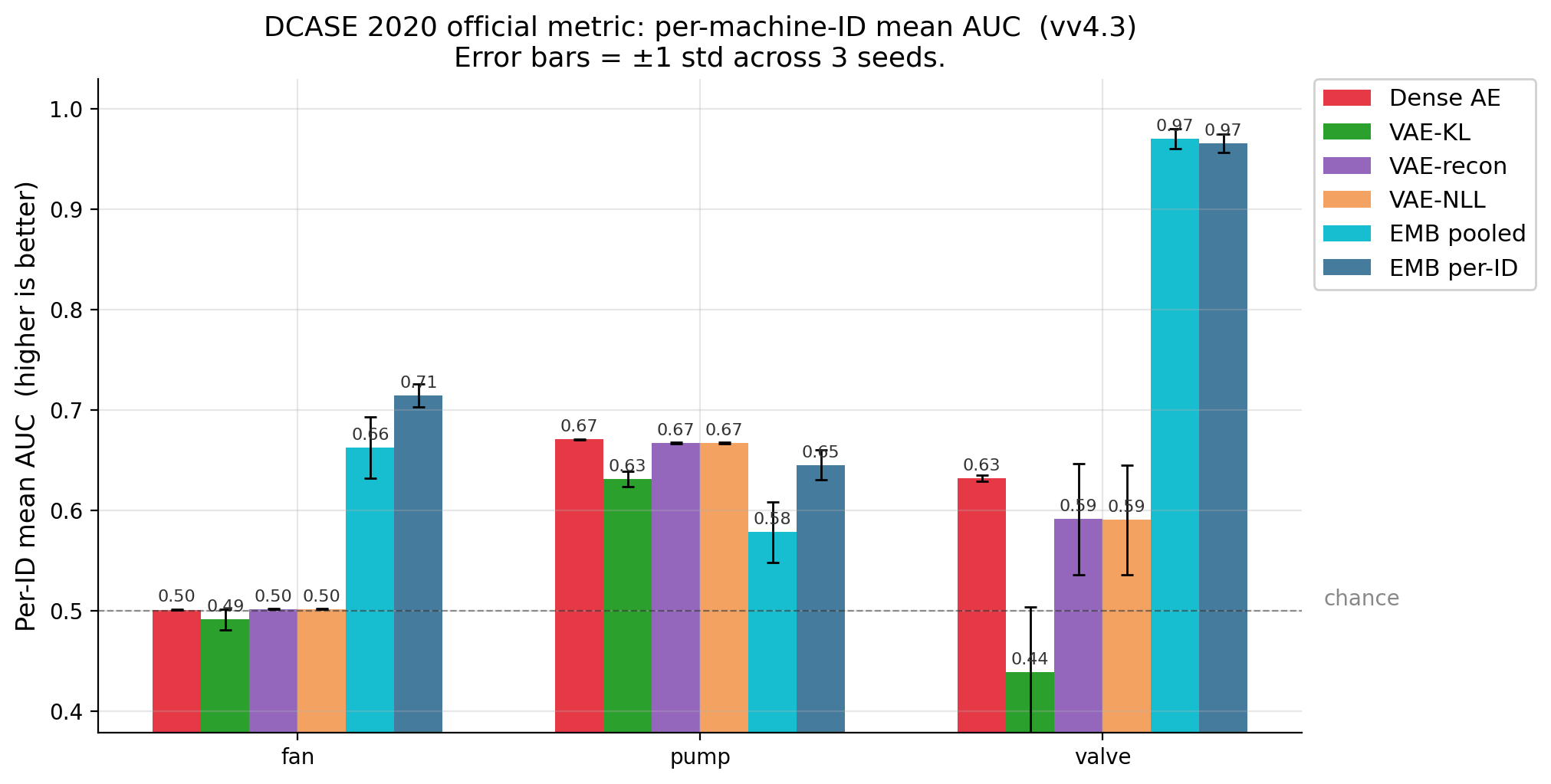
Per-machine-ID mean AUC-ROC for all detector families across fan, pump, and valve, averaged over 3 seeds with ±1 std error bars. The embedding model dominates on valve and fan; the Dense AE leads on pump.
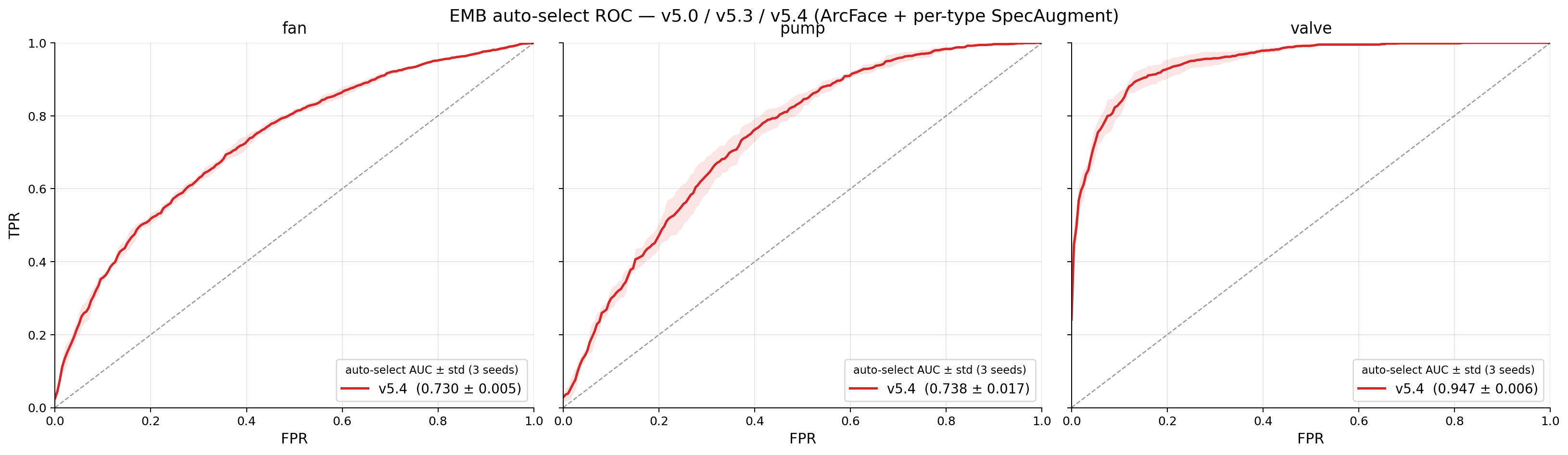
ROC curves on valve comparing oracle per-ID scoring against ArcFace pooled Mahalanobis scoring. The curves overlap: the deployment constraint of knowing the machine ID is removed without meaningful loss in detection performance.
Unsupervised anomaly detection on industrial machine audio, benchmarked on the MIMII pump dataset and DCASE 2020 Task 2 (fan, pump, valve at 0 dB SNR). Three detector families are compared in increasing order of sophistication: a Dense Autoencoder, a Transformer-VAE scored by ELBO and KL divergence, and an ArcFace-trained embedding model scored by Mahalanobis distance to the stationary distribution of normal embeddings. The deployed valve model requires no known machine ID at inference and reaches 0.947 AUC.
Key Features:
- Three Detector Families: Dense Autoencoder, Transformer-VAE (ELBO and KL scoring), and ArcFace embedding + Mahalanobis distance
- From-Scratch DSP: STFT, triangular mel filterbank, and patch extraction implemented in NumPy/SciPy, no librosa
- ArcFace Angular Margin Loss: Tightens per-machine-ID clusters on the hypersphere for reliable scoring without a known machine ID
- Pooled Mahalanobis Deployment Scoring: Single LedoitWolf distribution fitted across all machine IDs, no oracle ID required at inference
- Gradio Web App: Upload a .wav recording and get a verdict, anomaly score, and percentile against the calibration distribution
- HuggingFace Hub Integration: Models downloaded and cached automatically on first run
- CLI + Python API:
iaad score,iaad ensemble,iaad evaluatecommands, plusAnomalyDetector/EnsembleDetectorclasses - Full Test Coverage + CI: pytest suite, Ruff linting, pre-commit hooks, GitHub Actions CI
Results (per-machine-ID mean AUC-ROC, chance = 0.500):
| Detector | Fan | Pump | Valve |
|---|---|---|---|
| Dense AE | 0.501 | 0.671 | 0.632 |
| Transformer-VAE (recon) | 0.501 | 0.667 | 0.591 |
| Transformer-VAE (KL) | 0.491 | 0.631 | 0.439 |
| EMB per-ID (oracle) | 0.714 | 0.645 | 0.966 |
| EMB pooled Mahalanobis (deployed) | 0.730 | 0.738 | 0.947 |
Datasets:
- MIMII pump (Purohit et al., 2019): single machine type, ~380 normal and 136 anomalous clips at 16 kHz
- DCASE 2020 Task 2 (Koizumi et al., 2020): fan, pump, and valve at 0 dB SNR, 4 physical machine units per type
Technologies: Python 3.11+, TensorFlow, Keras, Transformer, ArcFace, Gradio, HuggingFace Hub
Status: Production Ready | Apache 2.0 License
→ View on GitHub
→ Read the Blog Post
→ View Model on HuggingFace
→ View on Kaggle: MIMII Pump Baseline
→ View on Kaggle: DCASE 2020 Benchmark
Open Source Contributions
All public projects available on GitHub